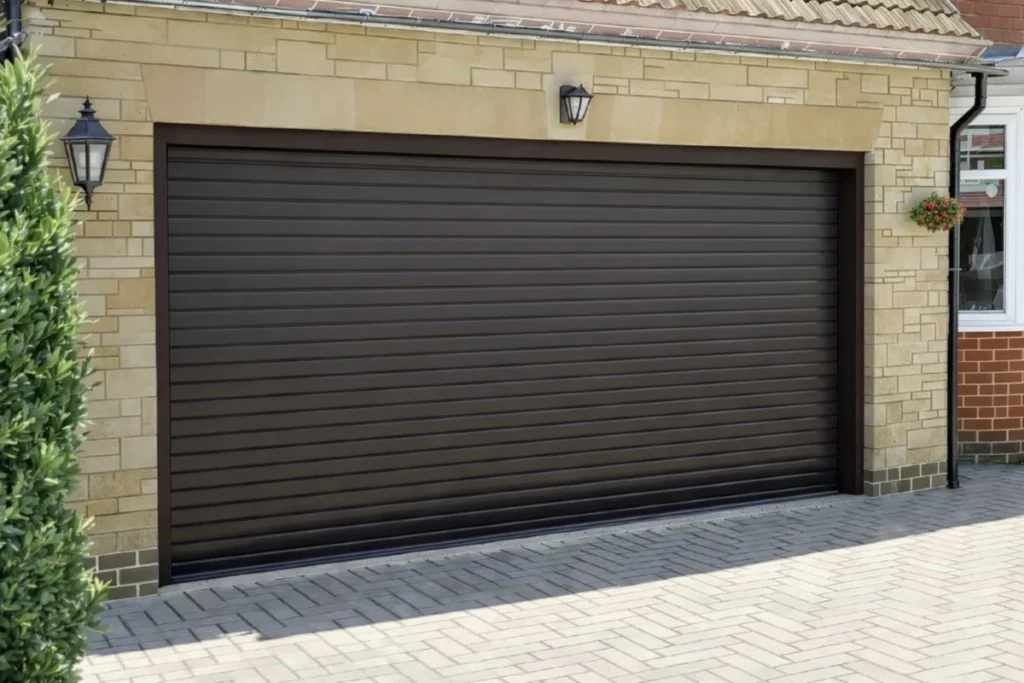
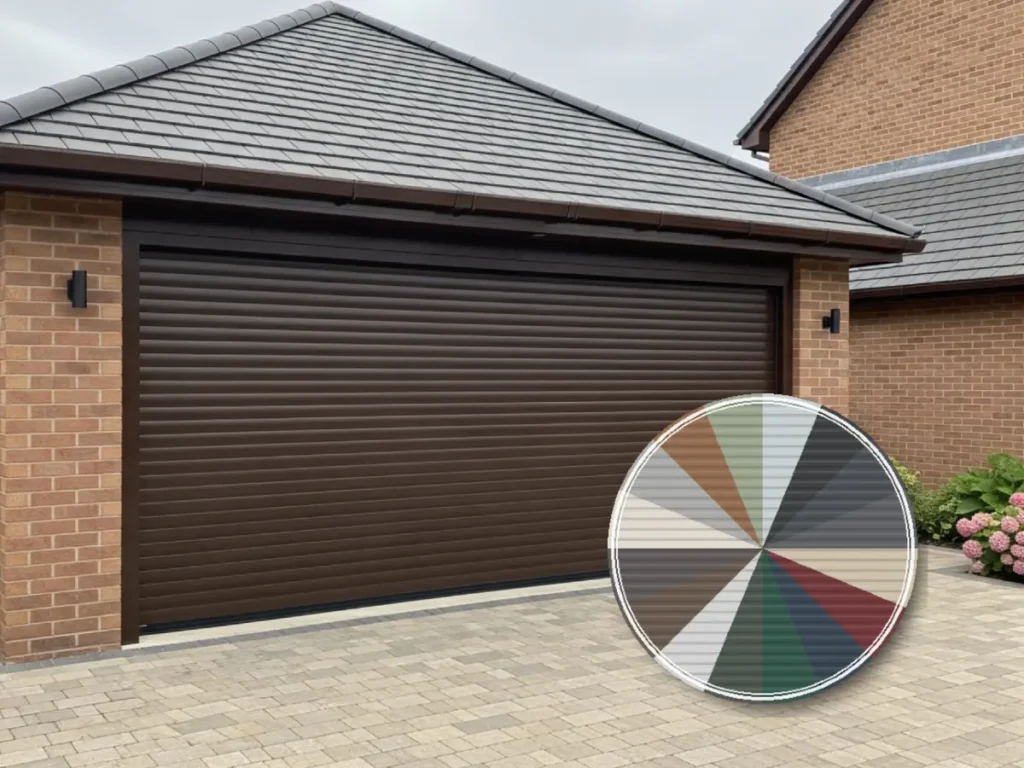
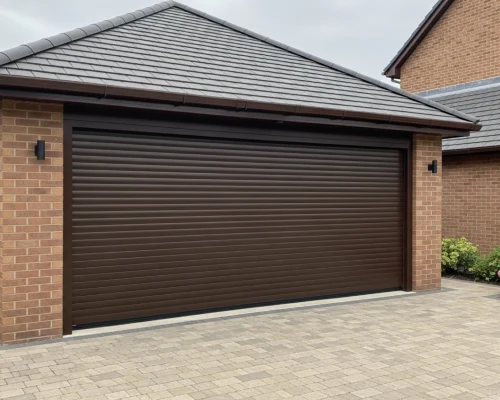
A roller garage door may look simple from the outside, but several parts work together every time the door opens or closes.
The curtain rolls around a barrel. The motor turns the barrel. The side guides keep the curtain straight. The control panel tells the door when to move. The safety edge helps the door respond if it meets an obstruction.
Understanding these parts makes it easier to choose the right door, order the correct accessories and explain a problem if something stops working.
This guide explains the main parts of an electric roller garage door in plain English.
What is a roller garage door?
A roller garage door opens vertically and rolls into a compact coil above the opening.
Instead of swinging out like an up-and-over door or sliding back under the ceiling like a sectional door, a roller door lifts straight up. The curtain rolls around a barrel inside the top box, which helps save space on the driveway and inside the garage.
This makes roller garage doors popular for:
- Short driveways
- Garages close to the pavement
- Garages with limited ceiling space
- Homeowners who want electric operation
- Made-to-measure replacement doors
- DIY roller garage door kits
- Compact openings where a neat finish matters
Most modern domestic roller garage doors use insulated aluminium slats, a tubular motor, side guides and a control system.
Main parts of a roller garage door
The main parts are:
- Curtain
- Slats
- Bottom rail
- Side guides
- Barrel
- Top box
- End plates
- Tubular motor
- Control panel or receiver
- Remote fobs or key switch controls
- Safety edge
- Manual override
- Weather seals and fixings
Some doors include extra accessories, such as smart phone control, external manual override, upgraded controls or additional remote fobs.
Roller curtain
The curtain is the main moving part of the door.
It is made from individual horizontal slats that connect together to form one flexible curtain. When the door opens, the curtain rolls up around the barrel. When the door closes, it unrolls down through the side guides.
On an insulated aluminium roller garage door, the curtain is normally made from foam-filled aluminium slats. This helps reduce draughts and gives the door a stronger, more finished feel than a thin single-skin curtain.
The curtain affects:
- Strength
- Appearance
- Insulation
- Noise
- Weight
- Required motor size
- Maximum opening width
- How compactly the door rolls up
If the curtain is damaged, crooked or catching in the guides, do not keep running the door. A curtain fault can quickly become a motor or guide problem if forced.
Slats
Slats are the individual horizontal sections that make up the curtain.
The slat profile matters because it affects the strength, roll size and suitable opening width.
A smaller slat profile is usually better for compact openings where headroom is limited. A larger slat profile is usually better for wider openings because it gives more stability across the door width.
As a simple guide:
- 55mm slats are usually used for smaller and standard single garage openings.
- 77mm slats are usually used for wider single garages, double garages and larger domestic openings.
TWF’s Roller Door Options separate Standard 55, Premium 55 and Classic 77 so customers can choose a door range that suits the opening size and use.
Bottom rail
The bottom rail sits at the bottom of the curtain.
It helps the curtain close neatly against the floor and gives the bottom of the door a more solid finish. Depending on the door system, the bottom rail may also work with a rubber seal or safety edge.
The bottom rail matters because it affects:
- How the door meets the floor
- Weather sealing
- Stability of the curtain
- Safety edge fitting
- The finished look of the door
If the bottom rail is bent, loose or catching on the floor, the door may stop, reverse or close unevenly.
Side guides
Side guides are the vertical rails fitted on each side of the opening.
The curtain runs inside these guides as the door opens and closes. They keep the curtain aligned and help the door close securely.
Side guides are one of the most important parts of the system. If they are out of level, blocked, bent or fixed badly, the curtain can rub, jam or come out of line.
Good side guides help with:
- Smooth movement
- Security
- Wind resistance
- Weather sealing
- A neat close
- Reduced curtain movement
When measuring for a roller garage door, the side guides must be allowed for. The overall door size is not just the clear brick opening. The guides and top box also need space.
Barrel
The barrel is the tube that the curtain rolls around.
It sits above the opening, behind the top box. When the motor turns the barrel, the curtain rises or lowers.
The barrel must be matched to the door size, curtain weight and motor. A larger or heavier door may need a different barrel setup from a small single garage door.
The barrel affects:
- How smoothly the curtain rolls
- The size of the coil
- Motor compatibility
- The amount of headroom needed
- Long-term reliability
If the curtain winds unevenly around the barrel, stop using the door and get advice. Forcing a tangled or uneven curtain can damage the motor, slats and guides.
Top box
The top box is the housing above the opening that covers the rolled-up curtain and barrel.
It gives the door a clean finish and helps protect the curtain and motor assembly from weather and dirt. It also makes the door look more complete from the outside.
The size of the top box depends on the door type, slat size and curtain height. A compact 55mm system usually needs a smaller top box than a larger 77mm system.
The top box matters for:
- Appearance
- Weather protection
- Headroom requirements
- How the door fits above the opening
- Whether the door can be fitted behind or within the opening
This is why measuring headroom is important before ordering a made-to-measure roller garage door.
End plates
End plates sit at each side of the barrel and top box assembly.
They help support the barrel, motor end and opposite end of the roller assembly. They also connect the top assembly to the side guides and fixing points.
End plates are usually not the first part a homeowner thinks about, but they are important for strength and alignment.
If the end plates are not fitted squarely, the barrel and curtain may not run properly.
Tubular motor
The tubular motor is the electric motor that drives the door.
It usually sits inside the barrel. When powered, it turns the barrel and moves the curtain up or down.
The motor must be correctly sized for the door. A small, lightweight door does not need the same motor as a wider and heavier door. Motor size is usually described using torque, measured in Nm.
The motor works with:
- Control panel
- Remote fobs
- Wall controls
- Manual override
- Safety edge
- Barrel and adaptors
- Door curtain
A motor fault can cause the door to stop moving, move slowly, hum, overheat or work only intermittently. But not every movement fault is a motor fault. Control panel problems, safety edge issues and mechanical jams can look similar.
Control panel or receiver
The control panel is the box that manages the door’s electric operation.
It receives commands from the remote fob, key switch or wall control, then sends the correct instruction to the motor.
Depending on the system, the control panel may also connect to:
- Safety edge
- Photocells
- Wall buttons
- Remote receiver
- Smart controller
- Manual control inputs
- Indicator lights
If the door does not respond, the control panel may be part of the issue. But the first checks should always be simple: power supply, remote battery, wall control and obstructions.
Remote fobs
Remote fobs allow you to open and close the door without using a wall switch or key switch.
They must be compatible with the receiver or control panel. A fob that looks similar may still use a different frequency or coding system.
Remote fobs can fail because of:
- Flat battery
- Damage
- Water ingress
- Lost pairing
- Wrong replacement fob
- Receiver fault
- Control panel fault
If one remote works and another does not, the issue is probably the fob. If no remotes work, the issue may be the receiver, control panel or power supply.
Key switch controls
Some roller garage doors are supplied with key switch controls.
A key switch lets you operate the door from a fixed control point. This can be a practical option where remote controls are not required, or where a simple wired control setup is preferred.
For TWF DIY roller garage doors, standard kits are supplied with key switch controls. If remote controls are required, a suitable safety edge needs to be selected from the additional extras in the Garage Door Builder.
This is important because remote operation and safety features need to work together properly.
Safety edge
The safety edge is a safety feature fitted to the bottom of the door.
Its job is to help the door respond if the bottom edge meets an obstruction while closing. Depending on the system, the safety edge may signal the control panel to stop or reverse the door.
A safety edge is especially important when a door is operated remotely, because the person pressing the remote may not be standing directly beside the opening.
Do not bypass or ignore a faulty safety edge. If the safety edge is damaged or unreliable, repair or replace it properly.
Photocells or safety sensors
Some roller garage door systems use photocells or other safety sensors.
Photocells send a beam across the opening. If something breaks the beam, the control system can stop or prevent the door from closing.
Not every domestic roller garage door has photocells, but where they are fitted, they need to be kept clean, aligned and working.
A sensor fault can make a door refuse to close even when the door itself is mechanically fine.
Manual override
A manual override lets you operate the door by hand if the power fails or the control system cannot be used.
On many roller garage doors, this is done with a winding handle from inside the garage. If the garage has no side door or internal access, an external manual override may be needed so the door can be opened from outside.
Manual override is important if:
- The garage has no other entrance
- A car is kept inside
- The consumer unit is inside the garage
- You need access during a power cut
- The door is used every day
A manual override should not be treated as an afterthought. It is part of practical access planning.
Supporting and safety components
Some roller garage door systems include additional supporting or safety components around the roller assembly, depending on the door model and specification.
The exact setup depends on the model, curtain size and door type. Larger or heavier doors may use different supporting components from smaller doors.
For homeowners, the important point is that the door should move smoothly and should not drop, jerk or feel uncontrolled.
If a door drops suddenly, feels loose or moves unevenly, stop using it and call a specialist.
Weather seals
Weather seals help reduce draughts, dust and rain entering around the door.
Common sealing areas include:
- Bottom of the door
- Side guides
- Around the top box
- Edges of the opening
No garage door can make every garage perfectly airtight, especially if the brickwork or floor is uneven. But good sealing can make a noticeable difference to comfort, stored items and day-to-day use.
If the floor is very uneven, the bottom seal may not sit perfectly across the full width.
Fixings and fitting components
Fixings hold the guides, top assembly and control components in place.
They may not be exciting, but they matter. A roller garage door must be fitted square, level and secure. Poor fixing can affect alignment, movement, security and long-term reliability.
A made-to-measure DIY kit should include the essential fitting components and instructions, but the wall condition still matters.
Before fitting, check:
- Brickwork or structure is sound
- Opening is square enough
- Headroom is suitable
- Side room is available
- Floor level is acceptable
- Power supply is planned
- The correct tools are available
How the parts work together
A roller garage door works as a complete system.
When you press a remote or key switch, the control panel sends a command to the motor. The motor turns the barrel. The curtain rolls up or down through the side guides. The bottom rail meets the floor when closed. The safety edge helps the system respond if the bottom edge meets an obstruction.
If one part is wrong, other parts can suffer.
For example:
- Bent guides can make the motor work harder.
- A damaged curtain can catch and jam.
- A poor power supply can make the controls unreliable.
- A faulty safety edge can stop the door closing.
- A wrong motor can strain the barrel and curtain.
- A badly fitted top box can affect the way the curtain rolls.
This is why buying a complete made-to-measure kit is often simpler than mixing random parts from different suppliers.
Which parts are included in a DIY roller garage door kit?
A made-to-measure DIY roller garage door kit usually includes the main door parts needed for installation.
A typical TWF DIY roller garage door kit includes:
- Insulated powder-coated aluminium slats
- Pre-fitted electric motor and control panel
- Key switch controls
- Emergency manual override system
- Side guides
- Roller assembly
- Fixings and essential fitting components
- Installation guidance and support
Remote-control operation may require the correct safety edge and control upgrade, depending on the selected setup.
Always check the order details before buying.
Which parts should you choose carefully?
Some parts are especially important to get right.
Slat size
Choose the correct slat size for the opening. A smaller 55mm slat can be better for compact openings, while 77mm slats are usually better for wider openings and larger doors.
Motor size
The motor must match the curtain weight, barrel and door size. Bigger is not automatically better.
Safety edge
If you want remote control operation, the safety edge and control setup must be suitable.
Manual override
If the garage has no other entrance, consider external manual override access.
Top box size
The top box must fit the available headroom and suit the curtain size.
Controls
Choose controls that suit how the door will be used. A simple key switch may be enough for some garages, while others need remote fobs or smart control.
Common part names customers get confused by
Curtain vs slats
The curtain is the whole moving door. The slats are the individual horizontal sections that make up the curtain.
Barrel vs top box
The barrel is the tube the curtain rolls around. The top box is the housing that covers the barrel and rolled-up curtain.
Motor vs control panel
The motor moves the door. The control panel tells the motor when to move.
Side guides vs frame
The side guides are the vertical rails the curtain runs in. They are not just decorative trim. They control the curtain’s movement and help secure the door.
Safety edge vs bottom seal
The safety edge is part of the safety system. The bottom seal helps close the gap at the floor. On some doors, these are integrated, but they should not be treated as the same thing.
Manual override vs remote control
A remote control operates the door electrically. A manual override lets you operate it by hand when power or controls are unavailable.
How to identify a faulty part
If the door is not working properly, the symptoms can help identify the likely part.
The curtain is crooked
Likely areas to check:
- Side guides
- Curtain
- Barrel
- Slats
- Fixings
Stop using the door if the curtain is visibly out of line.
The door hums but does not move
Likely areas to check:
- Motor
- Barrel
- Curtain jam
- Power supply
- Control panel
Do not keep pressing the remote. Repeated attempts can make the fault worse.
The door opens but will not close
Likely areas to check:
- Safety edge
- Photocells
- Obstructions
- Control panel
- Bottom rail
- Guides
Do not bypass safety devices to force the door closed.
The remote does nothing
Likely areas to check:
- Remote battery
- Receiver
- Control panel
- Power supply
- Remote pairing
Try a second remote or wall control if available.
The door is noisy or scraping
Likely areas to check:
- Guides
- Slats
- Bottom rail
- Curtain alignment
- Fixings
A roller door should not scrape heavily during normal use.
The door does not seal at the bottom
Likely areas to check:
- Bottom rail
- Bottom seal
- Floor level
- Curtain position
- Door setup
An uneven garage floor can affect the final seal.
When to repair a part and when to replace the door
A single faulty part can often be replaced if the rest of the door is sound.
Repair may make sense if:
- The motor has failed but the curtain is good
- A remote fob is damaged
- The control panel is faulty
- The safety edge needs replacing
- The guides are clear and straight
- The door is not very old
- The parts are available
A full replacement may make more sense if:
- The curtain is badly damaged
- The guides are bent
- The door has several faults at once
- The motor, controls and safety parts are all old
- The door is unsafe
- Replacement parts are no longer available
- The repair cost is close to a new door
- You want better insulation, colour or remote operation
If several parts are failing at the same time, a new made-to-measure roller garage door may be the better long-term option.
Safety advice for powered roller garage doors
An electric roller garage door is a powered moving door. Treat it with care.
Do not:
- Stand under the door while testing it
- Keep pressing the remote if the door is jammed
- Bypass the safety edge
- Pull the curtain out of the guides
- Force the manual override
- Touch live electrical parts
- Let children play with remotes or wall controls
- Ignore repeated stopping, reversing or scraping
If the door behaves unpredictably, stop using it until the cause is known.
Powered doors should be installed, maintained and repaired so they operate safely. If the issue involves controls, wiring, safety devices or a heavy moving curtain, get advice from a competent person.
Buying a new roller garage door: parts checklist
Before ordering a new roller garage door, check that the quote or kit covers the parts you need.
Ask:
- Is the door made to measure?
- What slat size is included?
- Is the curtain insulated?
- Are side guides included?
- What size is the top box?
- Is the motor included?
- What controls are included?
- Is there a manual override?
- Do I need an external manual override?
- Is a safety edge included or available?
- Are remote fobs included or optional?
- Are fixings and instructions included?
- Is support available after delivery?
This helps avoid comparing one basic door against a more complete kit.
Need a made-to-measure electric roller garage door kit?
Use the TWF Garage Door Builder to choose your size, colour, slat option and accessories. If you already have a roller door and need replacement parts, visit the roller garage door accessories shop for motors, control panels, remote fobs, safety edge products and manual override options.
Build Your Roller Garage Door
Shop Roller Garage Door Parts
Final advice
A roller garage door is more than a curtain and a motor.
The slats, guides, barrel, top box, controls, safety edge and manual override all need to work together. If one part is wrong, damaged or badly fitted, the whole door can become noisy, unreliable or unsafe.
If you are buying a new door, choose the correct slat size, motor, controls and manual access from the start. If you are repairing an existing door, identify the faulty part before ordering replacements.
When in doubt, take photos of the door, control panel and faulty part, then ask for advice before buying.
FAQs
What are the main parts of a roller garage door?
The main parts are the curtain, slats, bottom rail, side guides, barrel, top box, end plates, tubular motor, control panel, remote fobs or key switch controls, safety edge and manual override.
What is the curtain on a roller garage door?
The curtain is the moving part of the door. It is made from horizontal slats that roll up around the barrel when the door opens and lower through the side guides when the door closes.
What is the barrel on a roller garage door?
The barrel is the tube above the opening that the curtain rolls around. The motor turns the barrel to raise or lower the curtain.
What do roller garage door side guides do?
Side guides are the vertical rails on each side of the opening. They keep the curtain aligned as it moves and help the door close securely.
Is the motor the same as the control panel?
No. The motor moves the door. The control panel receives commands from the remote, key switch or wall controls, then tells the motor when to move.
What is a safety edge on a roller garage door?
A safety edge is a safety feature fitted to the bottom of the door. It helps the door respond if the bottom edge meets an obstruction while closing.
Do I need a manual override?
A manual override is strongly recommended for an electric roller garage door. If the garage has no other entrance, consider an external manual override so you can still open the door during a power cut.
Can I replace one part instead of the whole door?
Often, yes. Motors, remotes, control panels and safety edge parts can often be replaced if the rest of the door is sound. A full new door may be better if the curtain, guides and controls are all old or damaged.